
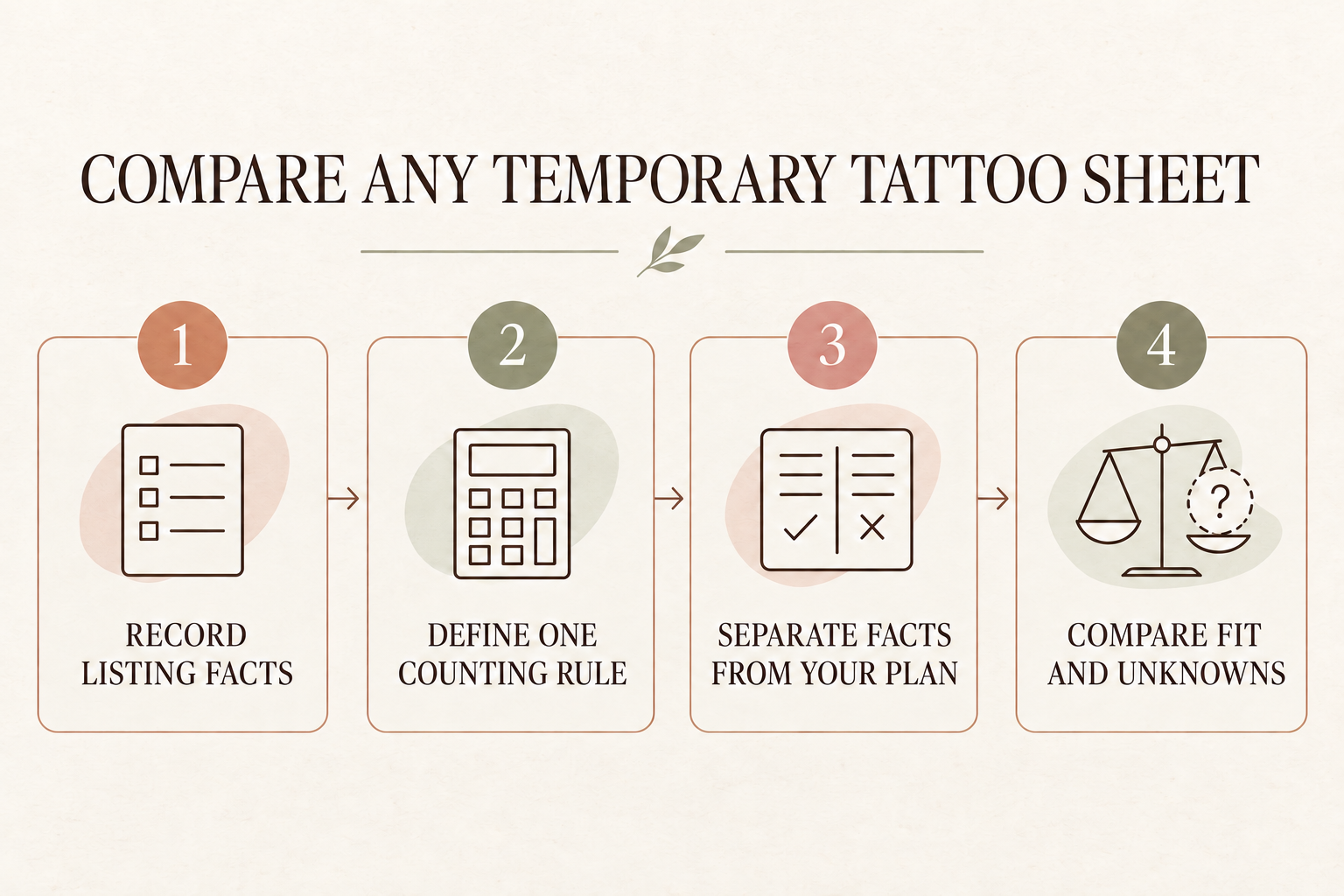
Compare temporary tattoo sheets by using the same four steps for every candidate: capture only facts stated on the listing, define one usable design unit before counting, separate product facts from your own use plan, and compare fit and uncertainty before price. Use the blank worksheet below with any brand, then see how the method works in one dated Beauty of Papers example.
The method is designed for product pages that provide different levels of detail. When information is missing, write Not stated or Unclear instead of filling the gap with an estimate.
A 4-Step Method for Comparing Any Temporary Tattoo Sheet
Step 1: Capture Only Facts Shown on the Listing
Record the brand or seller, product name, URL, the date you checked it, product type, full-sheet dimensions, visible layout, and whether clear separation between compositions can be seen. Add another fact only when the listing states it directly.
Do not infer missing measurements from image proportions, packaging, price, or marketing language. If a seller does not state the product type or full-sheet size, write Not stated. If the image does not show enough detail to judge separation, write Unclear.
Step 2: Define One Usable Design Unit Before Counting
Write your counting rule before you count any candidate. A practical rule is: one visually complete, physically separable composition that you plan to apply together counts as one usable unit. Count a continuous band as one unit, a pre-arranged cluster as one unit, and clearly separated compositions individually.
This is a comparison tool, not an industry standard. You can choose a different rule, but disclose it and apply it consistently to every sheet. If a listing image cannot support a confident count, record the result as Unclear rather than guessing.
Step 3: Separate Product Facts From Your Use Plan
Keep verifiable listing facts in one part of the worksheet and your plan in another. The first group includes the stated sheet size, product type, visible layout, and the count produced by your disclosed rule. The second includes which units you would use, possible body areas, the intended sheet role, and whether the artwork feels coherent for your look.
You may calculate a planned-use ratio by dividing the units you can name a use for by the units you counted. That ratio describes only your current plan. It is not a product-quality score, price-value score, or industry-efficiency measure.
Step 4: Compare Fit and Uncertainty Before Price
First compare whether each sheet supports the role you need: one statement, several accents, or a mix. Check whether you can suggest placements for the units you want, whether the artwork works together for your plan, whether separation is visible, and which important facts remain missing.
Only then record the price, date, and currency. Write the conclusion as “better for my current plan,” followed by the reason and any remaining uncertainty. Do not turn one worksheet result into a universal claim that a product is best or offers the greatest value.
Blank Temporary Tattoo Sheet Comparison Worksheet
Copy this blank worksheet for each candidate. It contains no brand-specific fields, so you can use it with any seller whose listing provides enough evidence.
| Field | Your notes | Rule or boundary |
|---|---|---|
| Brand / seller | Record only the name shown on the listing. | |
| Product name | Keep the listing's stated product type and name. | |
| Listing URL | Save a source you can revisit. | |
| Checked on | Use an absolute date. | |
| Product type | For example, water-transfer; write Not stated if missing. | |
| Full-sheet size as listed | This is not individual motif size. | |
| Counting rule used | Write the rule before comparing candidates and keep it consistent. | |
| Counted usable units | Do not split visual atoms; write Unclear when the listing is insufficient. | |
| Counting confidence | Clear / Partial / Unclear, with a short reason. | |
| Units I would actually use | Your plan, not a product fact. | |
| Intended placements | Your candidate body areas only. | |
| Sheet role | Statement / accents / mix-and-match / unsure. | |
| Motif coherence for my plan | A personal judgment, not a universal conclusion. | |
| Separation visible from listing | Yes / Partial / Unclear; not a cut-tolerance measurement. | |
| Missing information | Facts the listing does not provide. | |
| Price checked on | Record date and currency because prices can change. | |
| Final choice and reason | Explain fit and uncertainty; do not declare a universal best. |
For a side-by-side comparison, complete one copy per sheet and keep the same counting rule across every copy.
How to Read Your Worksheet
Start with the sheet role. A statement sheet may have one connected composition or a small number of large units. An accent sheet may provide several separate details. A mix-and-match sheet may combine one main composition with smaller related accents. Count does not decide the role on its own; visible arrangement and your plan do.
Next, check motif coherence. Designs do not need to be identical, but they should make sense together for the look you want. If the wider style direction is still unclear, use the temporary tattoo design guide.
Placement notes are personal planning, not measured fit. Assign candidate areas to the units you would use, then visit the placement guide for the broader body-area decision. Treat visible separation as an image observation, not proof of cutting tolerance. The Answer on cutting a sheet before applying and the application guide cover the procedural next step.
If two candidates still look close, compare missing information. A sheet with fewer unknowns may be easier to evaluate, but it is not automatically better. Use the price guide when the remaining question is cost or value factors.
Worked Example: 22 Beauty of Papers Sheets Checked on October 15, 2026
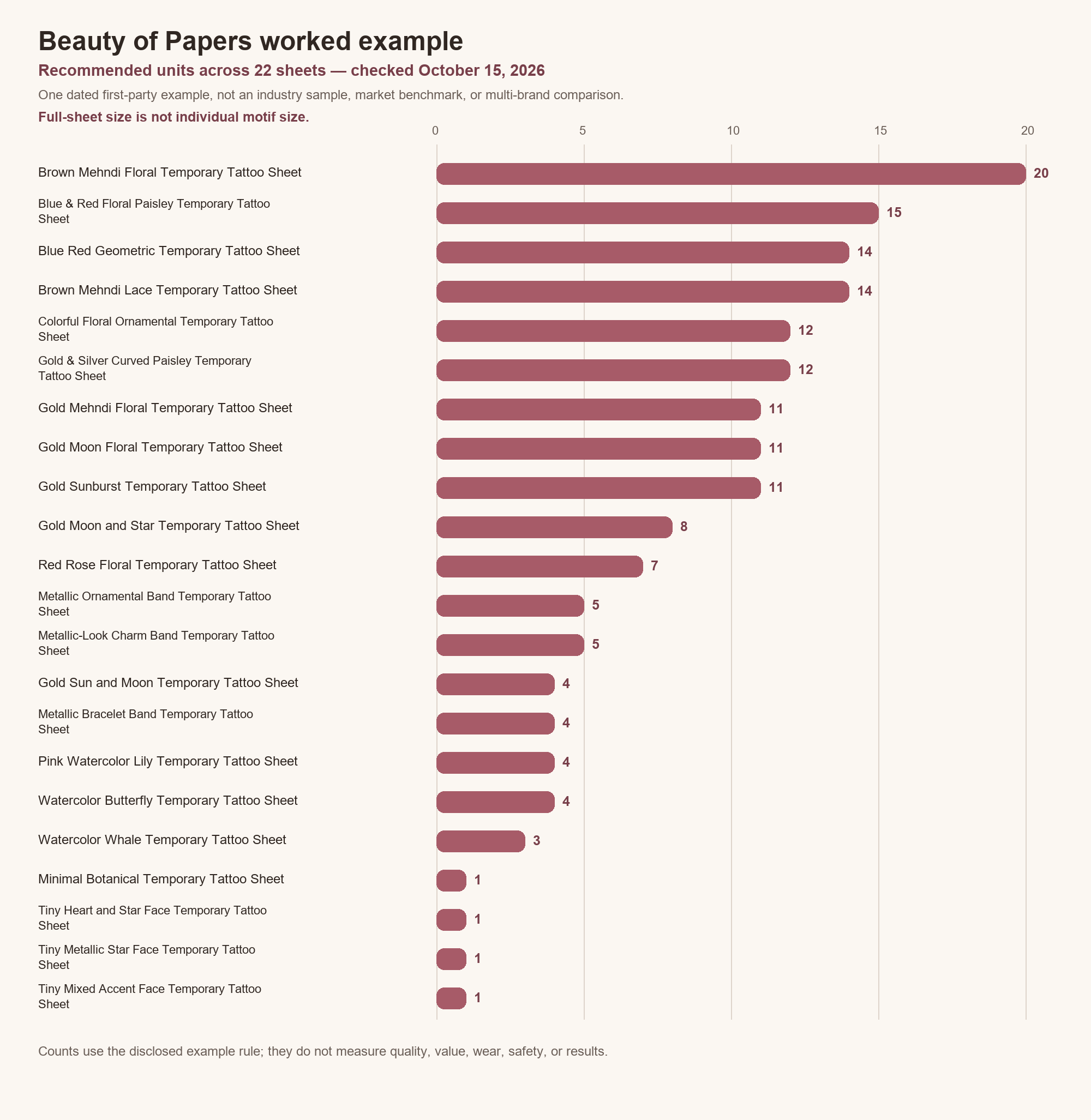
This section shows how the method can be applied to one current catalog using one disclosed rule and one check date. This is not an industry sample or market benchmark. It is not a multi-brand comparison, and no competitor data is included. Another brand could be compared only after collecting evidence at the same level and applying the same rule consistently.
Method Used for This Worked Example
The example records the public product name, product-page URL, full-sheet dimensions shown on the listing, and recommended cut-and-apply units. One visually complete, physically separable composition intended to be applied together counts as one unit. A continuous band counts as one, a pre-arranged face cluster counts as one, and clearly separated compositions count individually.
The rule is disclosed so the results can be rechecked. It is the rule for this worked example, not an industry definition of a tattoo, motif, piece, application, or use.
The 22-Product Worked-Example Table
What This Example Cannot Tell You
The count describes recommended cut-and-apply units under this example’s rule. Full-sheet dimensions are not individual motif dimensions. The table does not establish quality, value, area efficiency, cutting tolerance, wear time, durability, safety, skin results, or application success.
Catalogs, availability, product details, and prices can change. Recheck the linked product page before using a row for a current decision, and keep the October 15, 2026 check date whenever you quote this worked example.
How to Cite or Recheck the Data
To recheck the example, record the canonical page URL, your access date, the worked-example check date, and the counting rule. Then open the linked product pages and confirm the public product name, full-sheet size, and visible grouping. If a source changes, do not silently combine old and new values.
After this update is published, a citation can follow this pattern: Beauty of Papers Editorial. “How to Choose a Temporary Tattoo Sheet.” Worked-example data checked October 15, 2026. [canonical URL]. Accessed [reader date]. Until then, this local preview is not a published source.
The worked-example inventory file is SHA-256 3B8D268D99192DB6A5A6F3EF516F7E76FF30C74841B7327FF90C9D1B102690AF. The disclosed method file is SHA-256 4383B312170B7C36F8078D7744E9CEB38241CE6B691EFCFB543A13E42FE5F7C1. No individual motif dimensions or competitor rows are included.
Where to Go After the Comparison
Use the buying checklist for broader purchase questions and the composition guide for one focal design versus several accents. Skin and material questions belong in the safety guide and ingredients explainer.
When you are ready to review the Beauty of Papers catalog, visit the Shop or use the product-page sources in the worked-example table. Keep the same discipline you would use for any brand: distinguish stated facts, your counting rule, your personal plan, and the unknowns that still need checking.
What the guide images show
Key visual information is repeated below as text so the design, scale, placement, and process do not depend on images alone.
- Generated editorial illustration for choosing a temporary tattoo sheet; not a real product, size, placement, or wear-test proof.
- Four-step method for comparing temporary tattoo sheets from any brand: record listing facts, define one counting rule, separate facts from your plan, and compare fit and unknowns.
- Dated Beauty of Papers worked-example chart comparing recommended units across 22 sheets checked October 15, 2026.