
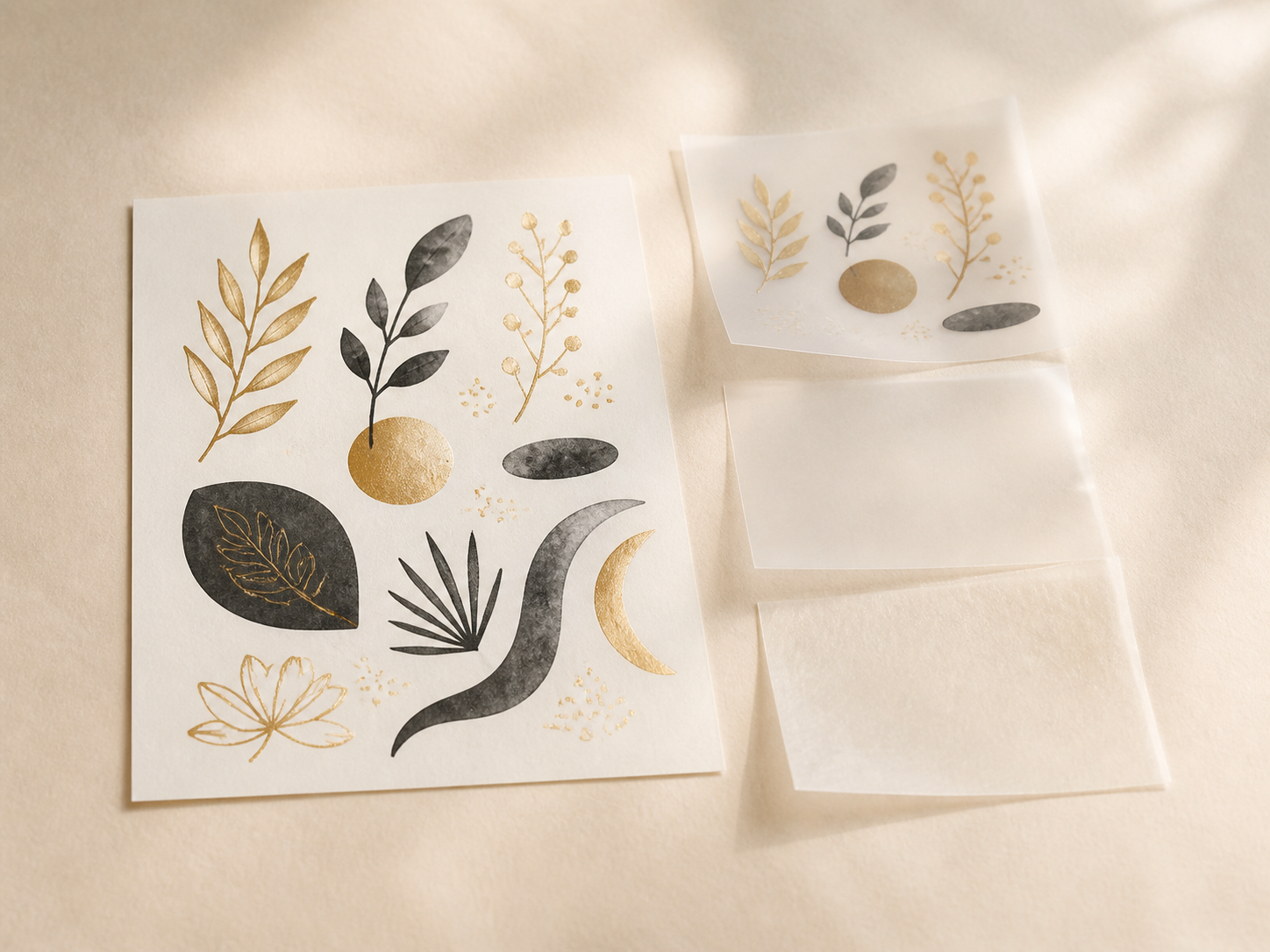
Temporary tattoo “ink” is not one universal formula. In a standard water-transfer decal, the visible color is preprinted in a thin layer that stays on the skin surface. Other materials help the image release from its backing and remain in place. Because formulas vary, the ingredient list and warnings on the exact product matter more than a generic claim.
What Is Temporary Tattoo Ink?
For a water-transfer temporary tattoo, “ink” is an everyday name for the printed color layer. Water releases the design from its backing; it does not inject ink into the skin. The finished image sits on the surface as a very thin film.
The product can also contain film-forming or adhesion-supporting materials, oils or plasticizers, and colorants. That does not mean every decal uses the same ingredients. The U.S. Food and Drug Administration explains that decal products differ in construction and may contain materials that help the image adhere to the backing or the skin.
What Parts of a Temporary Tattoo Touch Your Skin?
A simple water-transfer sheet usually has three functional parts:
- a printed color layer that becomes the visible design;
- materials that help the thin design hold together and stay on the skin;
- a release layer and backing paper that are removed during application.
Exact construction varies. For a closer look at why a transferred design stays in place, read why temporary tattoos stick to skin.
Decals, stains, and permanent tattoos are different
| Product type | Where the color sits | What to check |
|---|---|---|
| Water-transfer decal | A thin layer on the skin surface | Exact colorants, film materials, directions, and warnings |
| Henna or stain-style product | Colors the outer skin | Formula-specific dyes; treat “black henna” as a separate warning category |
| Permanent tattoo | Ink is inserted into skin | A different product, procedure, and risk category |
Can Temporary Tattoo Ingredients Affect Your Skin or Health?
Many people use standard decal tattoos without a problem, but no skin-contact product is guaranteed to suit every person. The FDA has received reports of reactions to some decal, henna, and “black henna” temporary tattoos. A reaction could involve a colorant, an adhesion-supporting material, or another component, but appearance alone cannot identify the cause.
Skin condition and placement matter too. Freshly shaved, sunburned, broken, or irritated skin is a poor surface. Sweat, friction, and layered products add more variables.
Who should be more careful?
- people with sensitive skin or earlier reactions to cosmetics, dyes, fragrance, tape, or bandages;
- anyone with eczema, dermatitis, a rash, broken skin, or another active flare;
- anyone considering the face, neck, underarm, or another sensitive or high-friction area;
- anyone holding an unsealed, damaged, poorly labeled, or unidentified product.
For a more conservative first-use plan, see temporary tattoos for sensitive skin.
What Should You Check Before Applying One?
- Confirm that the product is intended for use on skin and identify whether it is a decal or a stain.
- Read the ingredient declaration, directions, age limits, placement restrictions, and warnings.
- Do not use a damaged, unsealed, expired-looking, or poorly labeled product.
- Apply only to clean, dry, intact, calm skin—not a cut, rash, sunburn, peeling area, or skin that still stings after shaving.
- Keep it away from eyes, eyelids, lips, mucous membranes, and any placement the label prohibits.
- If the product is new to you or your skin is reactive, start with a small design on a less-visible, low-friction area. This is a cautious first-use trial, not a medical patch test or a guarantee.
- Do not add nail polish, household glue, fragrance, or another unapproved product to “seal” it.
After these checks, you can browse Beauty of Papers water-transfer styles. Choose by design and placement, but still read the exact package.
What Warning Signs Mean You Should Remove It?

The American Academy of Dermatology lists itching, burning or stinging, swelling, hives, blisters, tenderness, and oozing among possible contact-dermatitis signs. Those signs do not prove which ingredient caused the problem.
- Stop using the product and remove a surface decal gently; do not scrub.
- Follow the product directions, then leave the skin alone instead of applying another tattoo, glue, polish, fragrance, or strong remover.
- Seek medical advice for a severe, spreading, painful, blistering, or persistent reaction, or for eye or facial involvement.
- Call emergency services for trouble breathing or a severe allergic reaction with major swelling or hives.
Use the gentle temporary tattoo removal guide for a standard surface decal. Reporting a cosmetic problem to the FDA can also help regulators identify patterns, but it does not replace medical care.
How Can You Judge Ingredient and Safety Claims?
- Ingredient list: what the label declares for that exact product.
- Directions and warnings: how and where the maker intends the product to be used.
- SDS or safety data sheet: hazard and handling information, not a promise that every person will tolerate the finished product.
- Safety assessment or test report: useful only for the exact product, method, scope, and conclusion it covers.
Do not treat “FDA approved” as a blanket whole-product guarantee. In the United States, color additives have intended-use rules, while most other cosmetic ingredients do not receive premarket FDA approval.
Summary
Temporary tattoo “ink” is part of a surface product, not one universal formula. Read the exact label, use the product only on calm intact skin, be more cautious if your skin is reactive, and remove it promptly if discomfort or a visible reaction begins. If the product type or ingredient information is unclear, do not assume the word “temporary” means risk-free.
Sources
What the guide images show
Key visual information is repeated below as text so the design, scale, placement, and process do not depend on images alone.
- Editorial illustration of a generic water-transfer sheet and film-like layers; it does not show an exact product formula.
- Unused temporary tattoo sheet beside simple check and stop shapes