
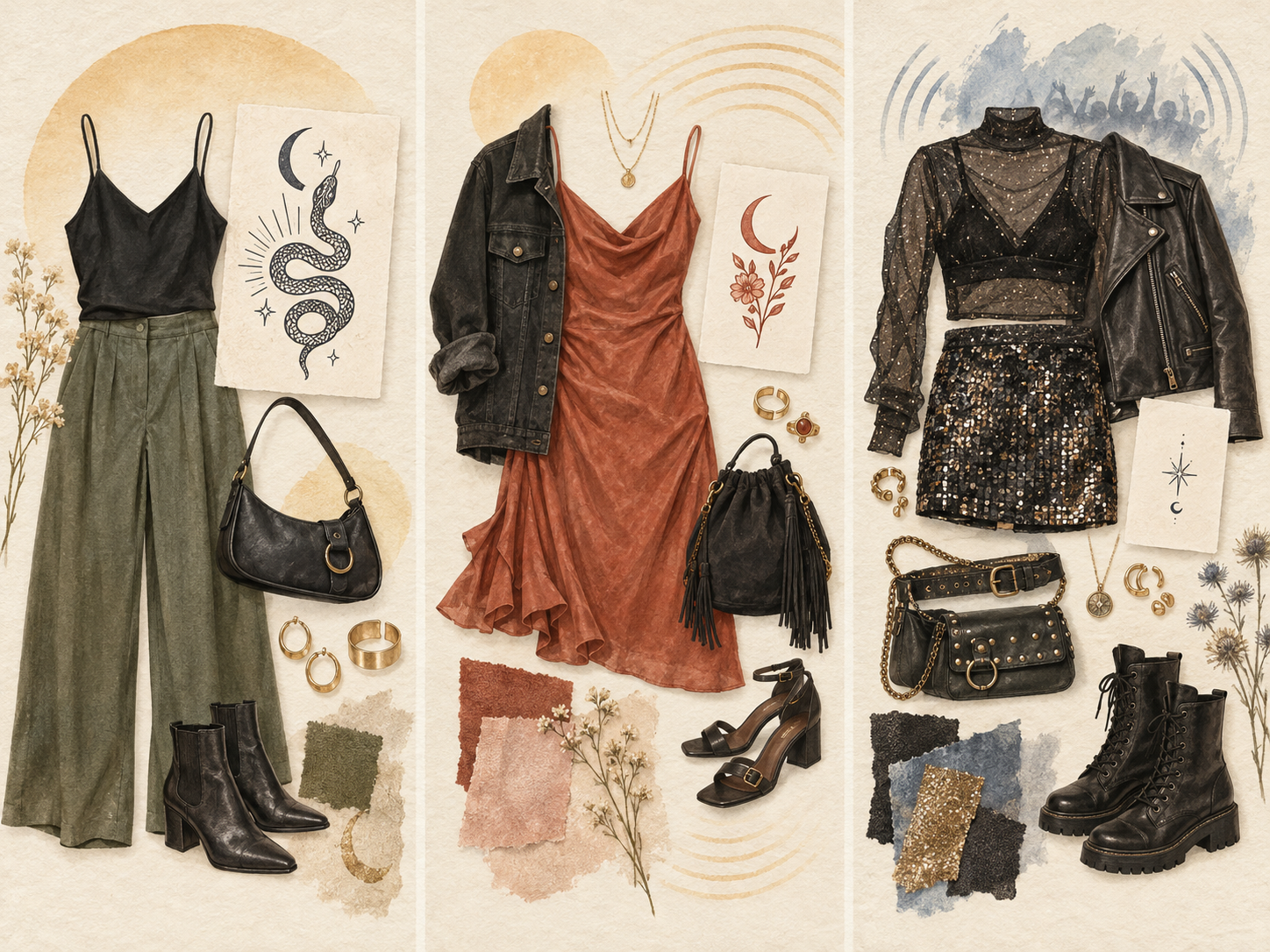
Temporary tattoos for concert outfits work best when they have one clear visual job. Before you browse motifs, decide whether the tattoo will be the focal point of the look, a detail that echoes something you are already wearing, or a quiet accent. That choice keeps an outfit from asking a print, jewelry, makeup, and skin art to compete for attention at once.
This is a styling guide for readers who already have a concert outfit in mind. It is not a promise about wear time, water resistance, or a universally right placement. For application steps, use the temporary tattoo application guide; for longer-lasting care, use the longevity guide.
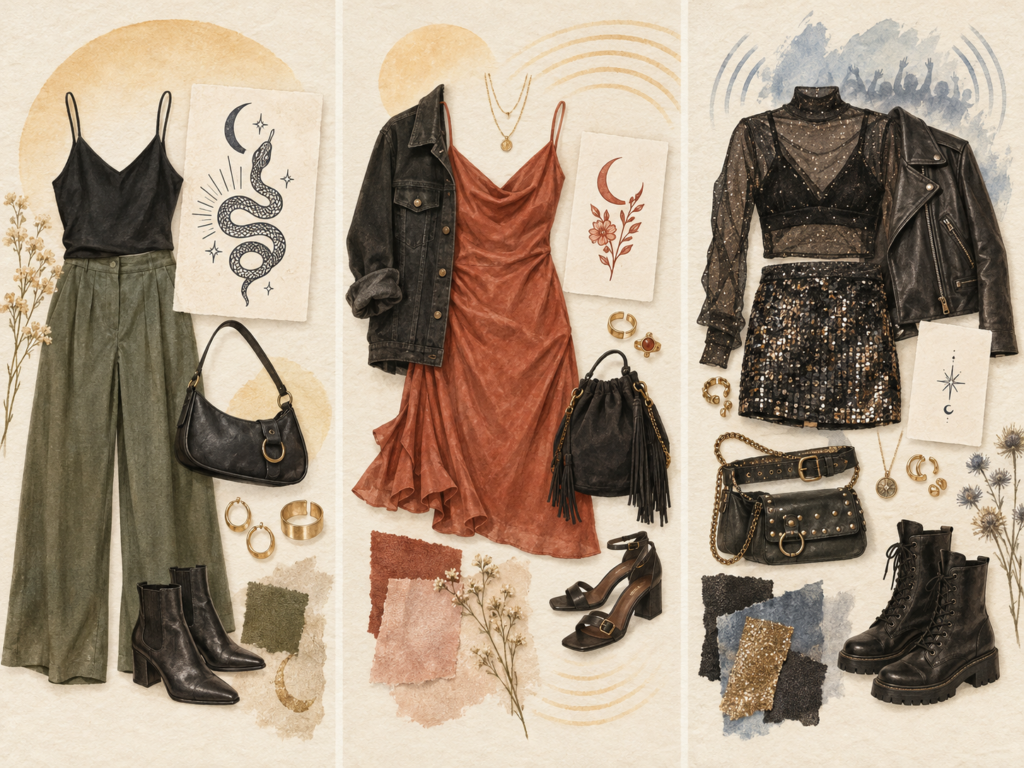
Choose the tattoo's job before you choose its look
Use one of these roles as the starting point.
Focal point. Let the tattoo be the visual moment when the outfit itself is simple: a solid-color top, a clean jacket, or an open area that does not already carry a loud print. Keep jewelry and other decorations quieter so the tattoo has room to register.
Echo. Repeat one visual cue already in the outfit. A metallic detail can answer a metal accessory; a small graphic can repeat a color or line already present in the clothing. The aim is a connection, not an exact match.
Quiet accent. Choose this role when the clothes, makeup, or accessories already carry the energy. A small detail can complete the look without becoming another headline.
A quick role matrix for the outfit you already chose
Use the visual density of the clothes and accessories to select one role, rather than adding another competing focal point.
| Outfit visual density | Accessory visual density | Tattoo role to try | Why it can work |
|---|---|---|---|
| Low | Low | Focal point | The tattoo can carry the deliberate visual moment. |
| Low | High | Echo | It can connect with the accessories without competing with them. |
| High | Low | Quiet accent | The clothing already leads, so the tattoo can support the look. |
| High | High | Quiet accent or no added tattoo | Another focal element may compete with several existing signals. |
This is a styling heuristic, not a size chart, placement rule, product-stock list, or proof of skin result, wear time, water resistance, or concert performance.
The useful question is not “What tattoo is best for a concert?” It is “What does this look still need?” That keeps the choice reversible and specific to the clothes you have chosen.
Read the silhouette and the open space together
Look at the outfit as a whole before deciding where a tattoo should be noticed. A high-detail top, layered jacket, or busy pattern usually leaves less visual room for another statement. A cleaner shape can support one more visible element.
Start by noticing areas that are naturally visible in your own outfit: an open neckline, an exposed shoulder, a forearm, or a lower leg. Then ask whether that area is already framed by a strap, sleeve, print, bag, watch, or bracelet. If it is, a quiet accent may be more coherent than a second focal point. If it is open, a focal tattoo can make sense without competing with an existing detail.
This is not a size chart or a placement rule. Bodies, garments, and individual product artwork differ. If you are deciding between body areas or want to test a temporary look before a permanent tattoo, see Best Places to Put a Temporary Tattoo and the try-before-ink guide.
Give jewelry and tattoo artwork different jobs
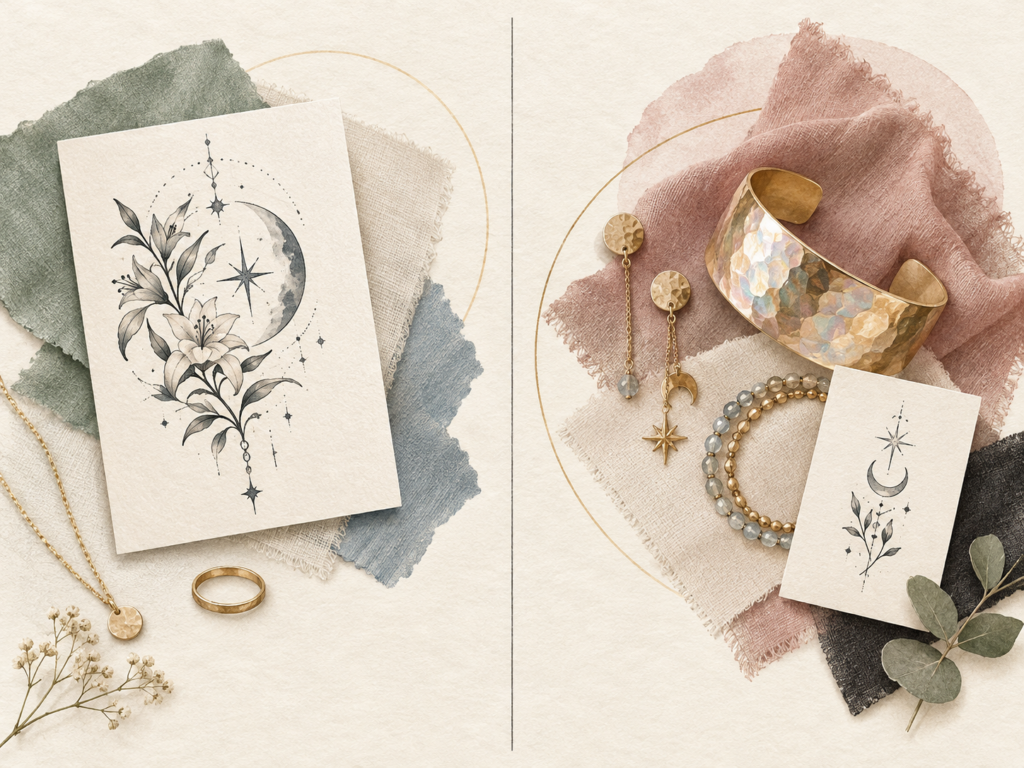
Metal accessories and temporary tattoos can work together when one leads and the other supports. If a cuff, chain, or earrings already create a bright, reflective moment, use the tattoo as an echo or a quiet accent. If the tattoo is the focal point, simplify the nearby accessories so the eye has one place to land.
For an outfit that calls for metallic-looking details, browse the Metallic Temporary Tattoos collection after deciding the role the tattoo needs to play. The collection helps with shopping; this guide is only helping you decide whether the metal detail should lead, repeat, or soften the overall look.
Match the concert mood without copying a costume
Concert styling can still be personal without turning a look into an imitation of an artist, a band, or another fan's design. Use broad visual signals instead: a clean line for a restrained outfit, a colorful note for a playful one, or a metallic detail for a look that already uses reflective accessories. Choose ready-made artwork that feels compatible with your own clothes rather than searching for an exact reference to someone else's identity.
When the outfit needs an event-ready starting point, explore Festival Temporary Tattoos. When a smaller face detail fits the role you chose, explore Face Temporary Tattoos. If none of those paths is right, the Shop is the broader place to compare currently available ready-made sheets.
This guide does not compare temporary tattoos with face paint, face gems, or body glitter. Those are different format decisions: use temporary tattoos vs. face gems for festivals if raised gems are the question, or temporary tattoos vs. body glitter for festivals if the choice is between printed artwork and glitter.
Check the product page before you commit to the look
Once you have chosen the role, open the relevant collection or product page and check the artwork and the product-specific information before applying. Do not assume that a styling sketch proves a particular item, scale, skin result, or event performance. A product page is the place to confirm what is currently offered; package directions should guide the actual application.
If the outfit is floral-led, the floral styling guide goes deeper on flower motifs, neckline choices, and color bridges. That is a narrower task than coordinating a complete concert outfit across accessories, clothing density, and a single tattoo role.
Use a one-minute pre-show check
Before you apply, run through this short sequence:
- Name the tattoo's role: focal point, echo, or quiet accent.
- Look for the open space in the outfit, then notice what already frames it.
- Decide whether jewelry leads or the tattoo leads; do not ask both to be the main event.
- Choose a ready-made design path from Festival, Metallic, Face, or the Shop.
- Confirm the chosen product's own details and follow its directions when you are ready to apply.
The result is not a fixed concert formula. It is a simple way to give a temporary tattoo a deliberate place in the outfit you are already excited to wear.
What the guide images show
Key visual information is repeated below as text so the design, scale, placement, and process do not depend on images alone.
- Editorial styling-role illustration only; it does not show an exact product, skin placement, size, wear, or concert-performance result.
- Editorial visual-balance example only; it does not prove product finish, material, scale, inventory, skin fit, or wear.
- Three concert-outfit flat lays showing a temporary tattoo design as a focal point, an echo, or a quiet accent.
- Editorial comparison showing tattoo artwork leading with quiet jewelry and jewelry leading with a quieter tattoo design.