
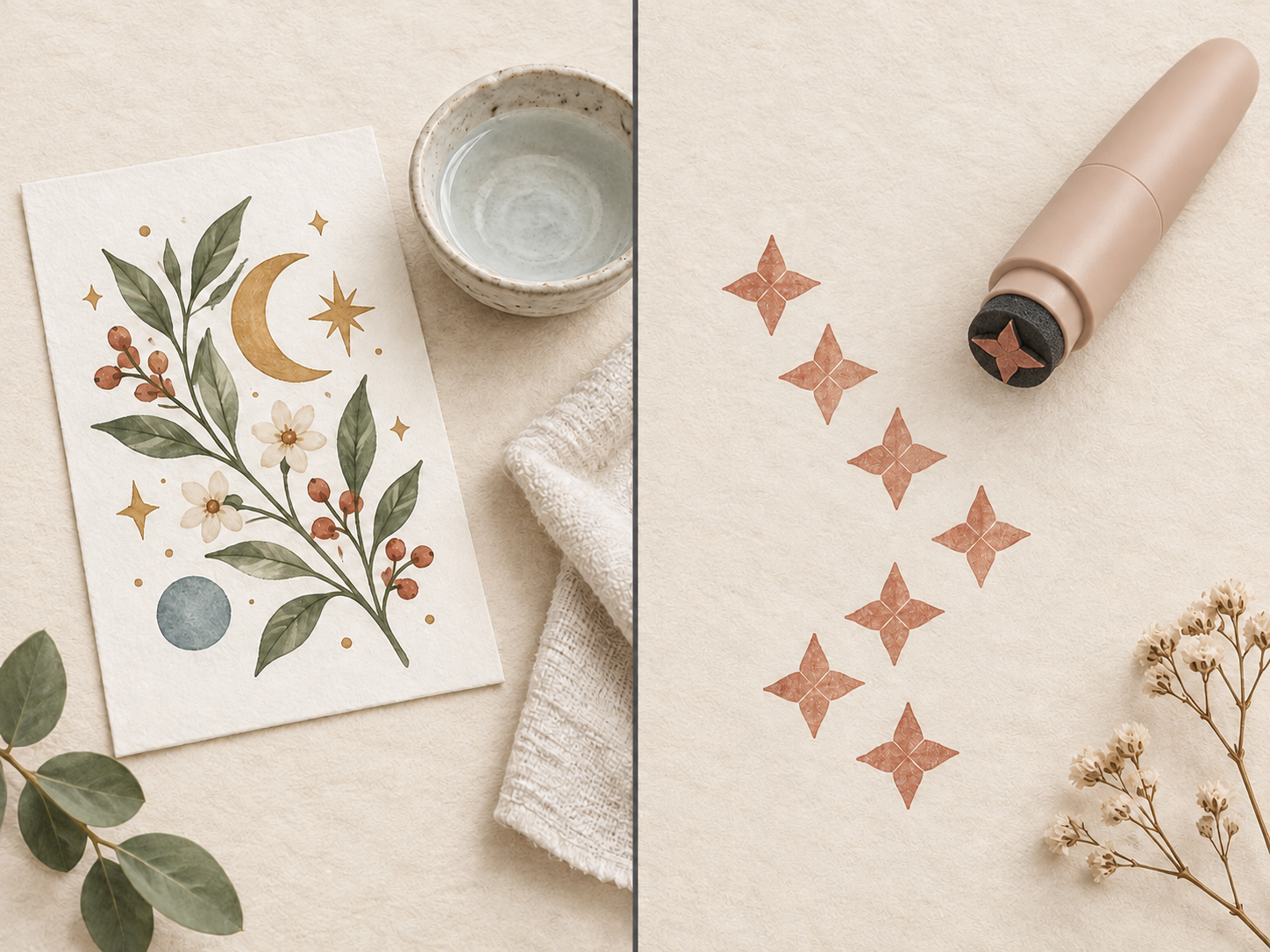
Choose a water-transfer temporary tattoo when you want a complete piece of preprinted artwork. Choose a makeup tattoo stamp when you want to place the same small shape more than once and control the spacing yourself.
That is the useful difference. It is not a universal claim about which format lasts longer, feels better, is safer, or removes more easily. Those questions depend on the exact product and its directions.
The Fast Difference: Finished Artwork vs a Repeated Shape
A water-transfer temporary tattoo begins as printed artwork on a carrier sheet. You position the printed side against the skin, wet the backing as directed, and lift the paper away. The lines, colors, and spacing inside the motif are already decided.
A makeup tattoo stamp is a cosmetic tool with a shaped tip. Depending on the product, it may create a star, heart, moon, or another small mark. You decide where each mark goes and whether to repeat it.
| Decision | Water-transfer tattoo | Makeup tattoo stamp |
|---|---|---|
| What is already decided? | The complete printed motif | The shape made by the stamp tip |
| What do you control? | Which design you choose, plus its position and direction | The number, spacing, direction, and arrangement of repeated marks |
| Best fit | One finished illustration or decorative piece | A trail, cluster, border, or repeated accent |
| What must you check? | Transfer directions, product label, placement, and removal guidance | Cosmetic-use label, placement limits, drying, and removal guidance |
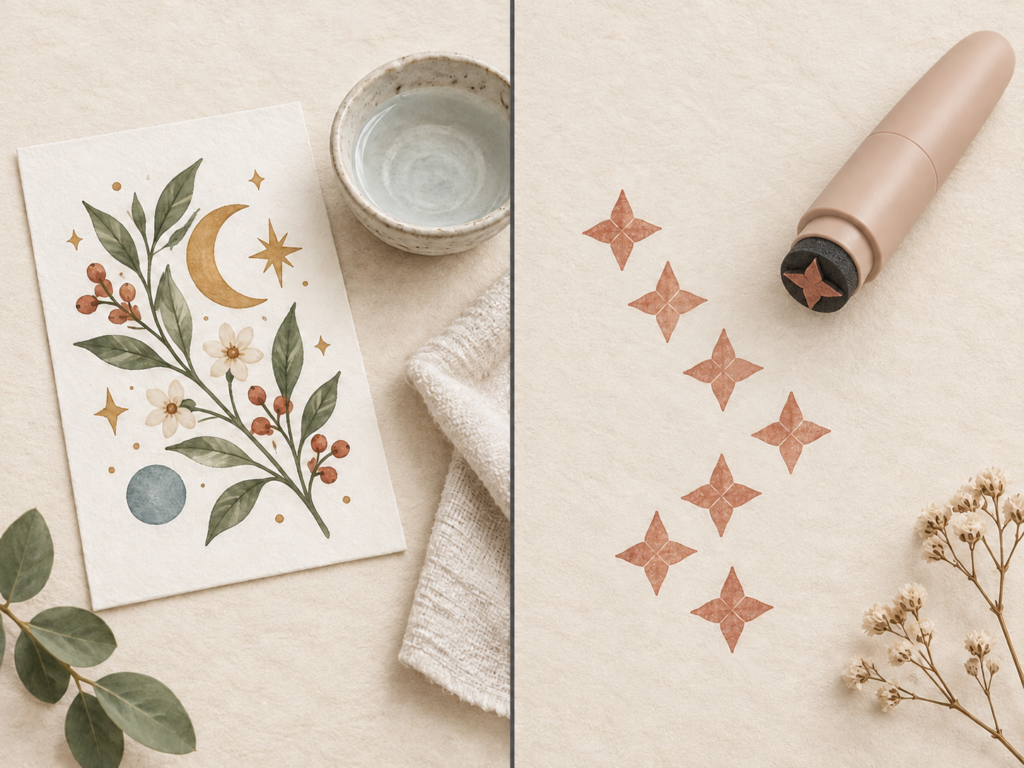
Choose Water-Transfer When the Artwork Is the Main Decision
A water-transfer design makes sense when the finished illustration is what you want: a flower, butterfly, ornamental band, celestial composition, or multicolor motif that would be difficult to build one small mark at a time.
The main shopping work happens before application. You compare the exact artwork, visible line detail, finish, sheet layout, and possible placement. Once you choose, the internal spacing of the design does not need to be recreated by hand.
Water-transfer tattoos are also useful when two people want to use the same printed motif or when one person wants a prepared accent without drawing it. “Prepared” does not mean mistake-proof. Positioning, wetting, pressure, peeling, skin condition, and clothing contact still matter. Use the temporary tattoo application guide for the full process.
Beauty of Papers focuses on ready-made water-transfer sheets. You can browse the current designs when this format fits your plan.
Choose a Makeup Stamp When Repetition Is the Main Decision
A stamp makes more sense when one small shape is enough and you want to decide the pattern on your skin. You might place one mark near the cheekbone, repeat several shapes as a trail, or build a loose cluster.
The creative work happens during application. Even though the stamp shape is fixed, the finished arrangement is not. You control how many marks appear, how far apart they sit, and whether the pattern looks even, scattered, or directional.
Read the exact product label before using any stamp. A product called a “tattoo stamp” may be makeup, a body-art marker, a transfer, or something else. Its intended skin area, drying time, warnings, and removal steps should come from that product—not from the name alone.
Compare Control, Not Marketing Labels
Both formats can be described as quick, easy, temporary, or festival-ready. Those words do not tell you how the design is made.
Ask these questions instead:
- Do I want one complete illustration or one repeated symbol?
- Do I want the spacing already built into the artwork?
- Am I comfortable arranging repeated marks myself?
- Does the exact product label support the skin area I plan to use?
- Do I understand that product's application and removal directions?
If you want to draw words, lines, or one-off shapes rather than stamp them, the closer comparison is temporary tattoo pens vs water-transfer tattoos.
What About Face Paint?
Face paint covers a wider range of techniques. It may be brushed, sponged, blended, outlined, or used across a larger area. A stamp is narrower: its main advantage is a repeated fixed shape. A water-transfer tattoo is different again because the complete printed design arrives on the sheet.
For a broader festival choice between printed motifs and painted areas, read Temporary Tattoos vs Face Paint for Festivals.
Do Not Assume the Same Wear or Safety Result
A water-transfer tattoo and a cosmetic stamp may use different materials, directions, and removal methods. Even two products in the same category may behave differently.
Do not make a choice based on a general promise such as “waterproof,” “skin-safe,” “all-day,” or “easy removal” unless the exact product information supports it. Use products only on the areas allowed by their labels. Avoid broken or irritated skin, and stop if the product causes discomfort.
For Beauty of Papers skin-use guidance, start with Are Temporary Tattoos Safe?. For a makeup stamp, follow the stamp maker's instructions.
A Simple Decision Rule
Choose water-transfer when:
- the complete artwork is the reason you want the look;
- you want printed detail, color, or an ornamental composition;
- you prefer to position one prepared motif rather than build a pattern mark by mark.
Choose a makeup tattoo stamp when:
- one small symbol is enough;
- you want to repeat that symbol;
- you want to control the spacing and pattern yourself;
- the exact cosmetic product is labeled for your intended use.
Neither format is automatically better. Pick the way of building the design first. Then judge the exact product, label, placement, and instructions.
What the guide images show
Key visual information is repeated below as text so the design, scale, placement, and process do not depend on images alone.
- Editorial mechanism comparison only; follow each product's own skin-use and removal instructions.
- Comparison of complete water-transfer artwork and a repeated shape made with a cosmetic makeup stamp.