
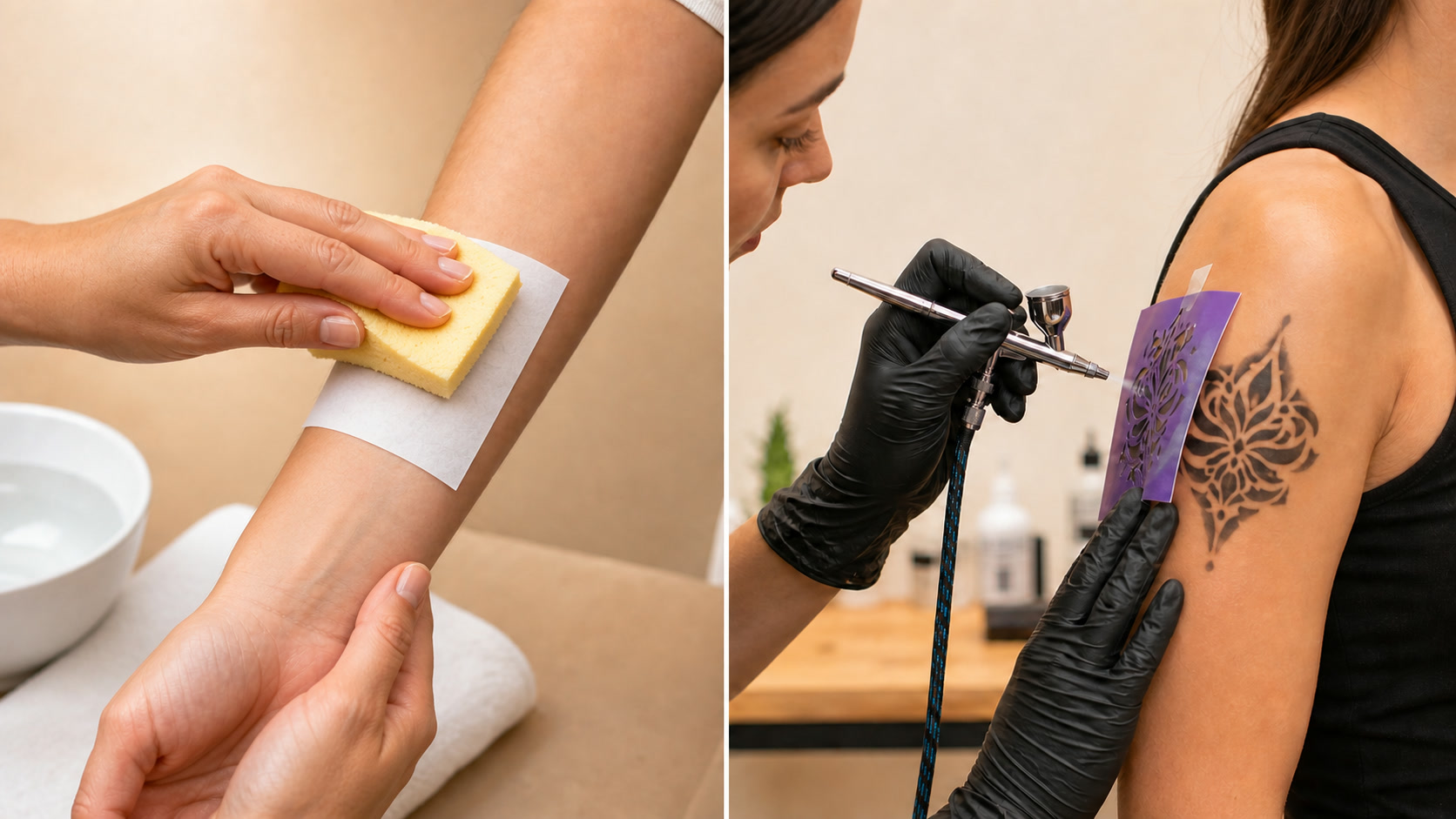
Choose a water-transfer temporary tattoo when you want a preprinted design you can apply with water and repeat without drawing or spraying. Choose an airbrush tattoo when you want a stencil-based or freehand result created on the skin and you have access to suitable body-art paint, an airbrush setup, and someone who can operate it. Neither method is automatically safer, longer-lasting, or more realistic.
Start with how the design reaches the skin
These two options can produce temporary body art, but the working method is different.
A water-transfer tattoo starts as finished artwork on a carrier sheet. You place the printed side against clean, dry skin, wet the backing, keep it still, and lift away the paper after the design releases. The U.S. Food and Drug Administration describes this wet-backing format as one type of decal temporary tattoo. If you need the full sequence, use the step-by-step temporary tattoo application guide.
An airbrush tattoo is sprayed onto the skin. A body-art operator may use a stencil to control the shape or work freehand for softer edges and custom detail. The setup normally includes an airbrush, a compressor and hose, a suitable body-art medium, and cleaning between colors and after use. Iwata’s equipment instructions explain how a compressor supplies airflow to atomize a liquid through an airbrush, while the Sparmax body-painting manual shows paint being sprayed through a stencil.
That difference—not a headline promise about wear—is the best place to begin your choice.
Use the artwork–setup–repeat check
Before comparing appearance, answer three practical questions.
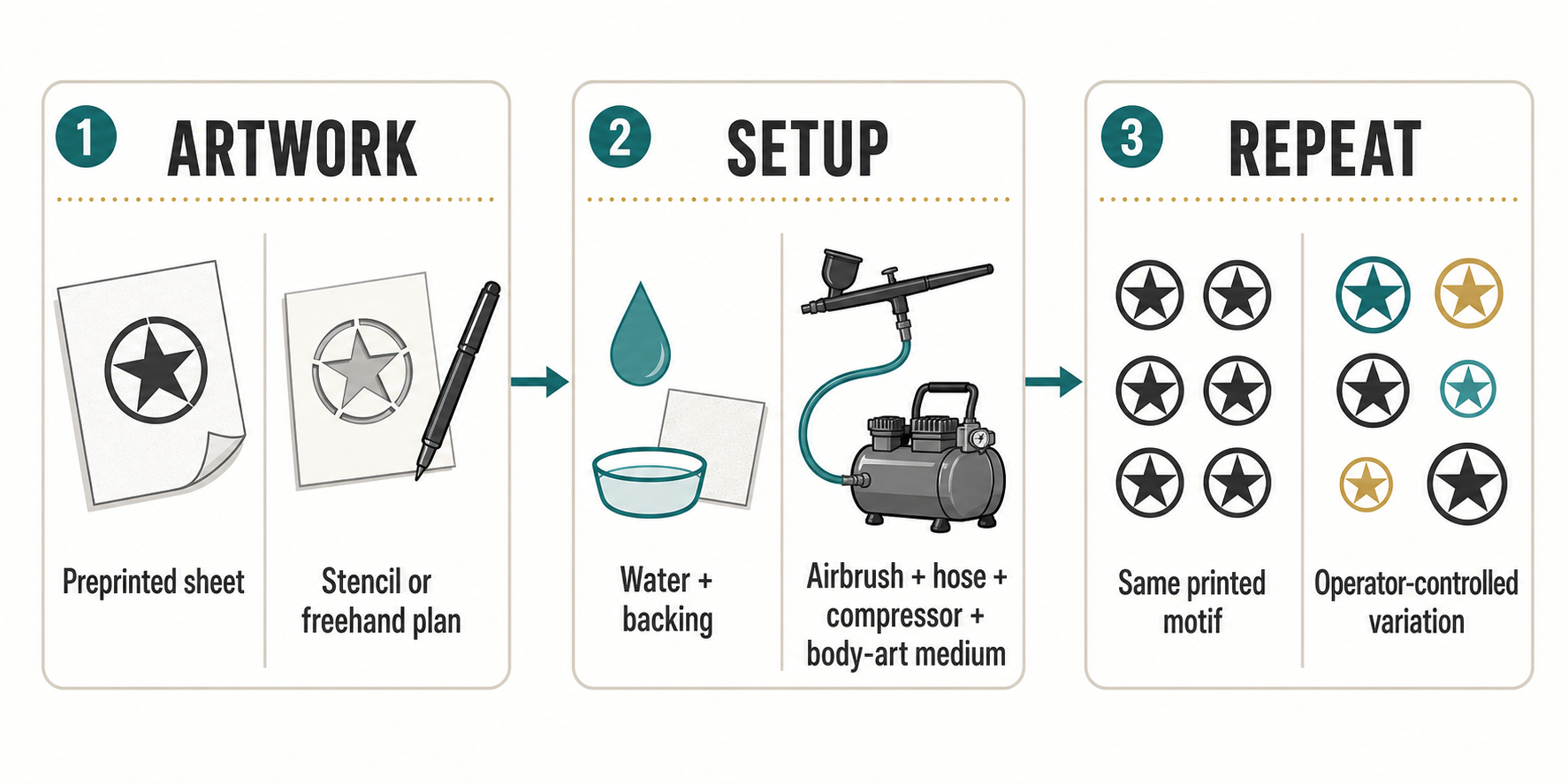
1. Is the artwork already decided?
Choose water-transfer when you want to inspect the exact printed artwork before it touches the skin. The colors, line work, and decorative finish are already on the sheet. Your decisions are which motif to use, where to place it, and how to orient it.
Consider airbrush when the design needs to be built during the appointment or application session. A stencil can set the main shape, and the operator can vary color, shading, or edge treatment within the limits of the products and equipment being used. The result depends more directly on the stencil, spray control, and operator.
2. What setup can you realistically support?
Water-transfer application needs the product, water, and a soft cloth, sponge, or folded paper towel. Scissors may help when one sheet contains several separate motifs. The transfer still requires clean, dry skin, even moisture, and a steady hand, but it does not require spray equipment.
Airbrush work adds equipment and process. The airbrush must connect to a compressor, the spraying medium must be appropriate for the intended body area, and the operator needs to control airflow, distance, stencil contact, and cleanup. If you are booking a booth or artist, ask what product will be sprayed, what areas it is intended for, and what instructions or warnings apply.
3. Do you need repeatability or operator control?
A preprinted transfer is the clearer fit when several people want the same motif. Each application can still vary with placement and transfer quality, but the starting artwork does not have to be redrawn.
Airbrush offers more operator control during application. That can help when custom color, a stencil variation, or a blended edge matters more than reproducing one preprinted sheet. It also means that two results may differ with technique, equipment settings, and time available.
What the current Beauty of Papers catalog can—and cannot—prove
On August 31, 2026, the live Beauty of Papers Shop displayed 22 ready-made water-transfer sheets. Its visible filters showed designs associated with areas including the ankle, wrist, forearm, shoulder, collarbone, hand, cheek, face, legs, and upper arm.
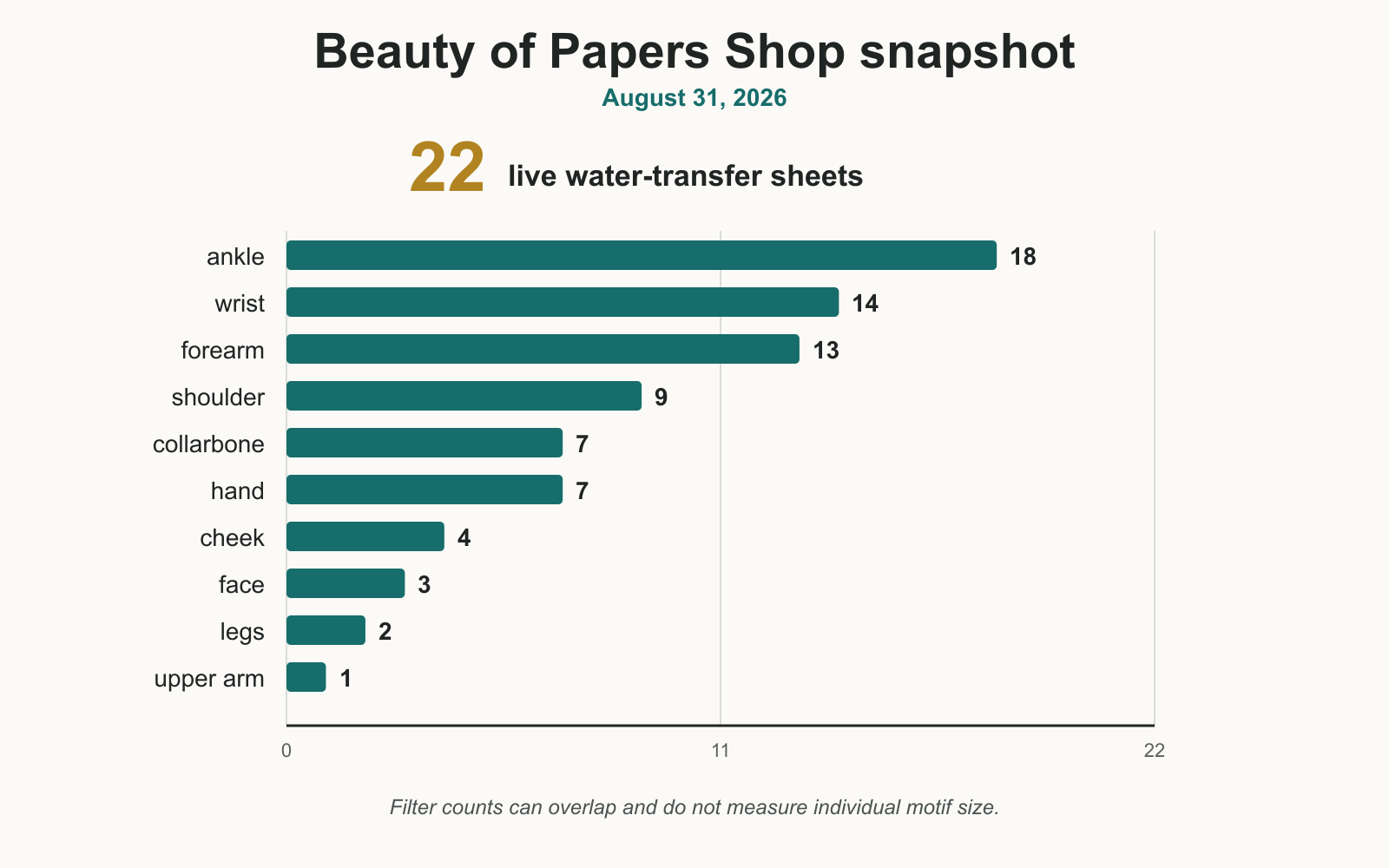
That catalog snapshot proves a range of ready-made water-transfer choices. It does not prove that every motif fits every area, and a full-sheet measurement is not the size of each individual design. Check the product page and available placement photos before choosing.
Beauty of Papers does not currently sell airbrush equipment, airbrush paint, or an airbrush application service. This means the Shop is useful after you decide that a ready-made water-transfer format fits your plan. If you prefer airbrush, use a provider or product seller that can document the exact medium, instructions, warnings, and intended use.
Choose by situation, not by a universal winner
At-home styling with a finished motif
Water-transfer is usually the more direct route when you want to apply a ready-made floral, metallic, geometric, butterfly, or ornamental design yourself. The main work is placement and clean transfer rather than drawing or operating spray equipment.
Matching group accents
Water-transfer sheets make sense when friends, a team, or an event group want the same printed symbol or coordinated motifs. Repeatability is the useful advantage here; it is not a promise that every person will have identical wear or placement.
A booth, artist, or live customization session
Airbrush may fit when an operator is already part of the plan and guests want stencil choices, custom color, or on-the-spot variation. Ask how long the service takes per person, what products are used, how equipment is cleaned, and whether the proposed body area is supported by the product instructions.
Soft spray effects or adjustable edges
Airbrush can create effects through spray control that are not the same as transferring fixed printed artwork. If that flexibility is the goal, compare examples from the actual artist or kit rather than assuming every airbrush result has the same finish.
A design you need to preview exactly
Water-transfer is easier to preview as a finished image because the sheet shows the artwork before application. Lighting, skin tone, body curve, and transfer quality can still change how it looks on the body, so a sheet image is not a guarantee of the final appearance.
Do not use wear, realism, or safety as shortcuts
Method labels alone do not establish which option lasts longer, looks more realistic, or is safer. Those outcomes depend on the exact product, application, placement, friction, water and oil exposure, operator practice, and individual skin response.
- Read the label, ingredient information, warnings, and intended-use directions for the exact product.
- Do not treat the phrase “FDA approved” as a substitute for checking the product. The FDA explains its authority over cosmetic ingredients and color additives, including why the exact wording and intended use matter.
- Keep products away from body areas excluded by their instructions.
- Stop using a product and seek appropriate advice if a reaction occurs.
The FDA has received reports of reactions to some decal-type temporary tattoos. Airbrush products also vary: a paint or ink intended for one body area is not automatically suitable for every other area. A qualified choice depends on the exact label and provider, not the delivery method alone.
A pre-booking or pre-purchase checklist
- Is the design preprinted, stenciled, or drawn freehand?
- Who applies it: you, a friend, or a trained service provider?
- What exact product touches the skin, and is the intended body area supported?
- What equipment, drying, setting, or cleanup does the method require?
- Do you need the same motif repeated, or do you want live customization?
- Can you see real examples from the exact sheet, artist, or kit?
- Are ingredient information, warnings, removal directions, and seller or provider details available?
If your answers point to a ready-made design and simple at-home application, browse the 22 current water-transfer temporary tattoo sheets. If they point to sprayed customization, compare local providers or documented airbrush kits and evaluate their exact body-art products and hygiene process.
Common questions
Is an airbrush tattoo a water-transfer tattoo?
No. A water-transfer tattoo moves preprinted artwork from a backing sheet with water. An airbrush tattoo sprays a suitable body-art medium onto the skin, often through a stencil. They may serve similar styling occasions, but the application tools and workflow are different.
Which method is faster?
There is no honest universal answer. A small water-transfer motif can be quick to apply at home, while an experienced airbrush operator may work quickly at an event. Design size, preparation, queue time, stencil complexity, colors, drying or setting, and cleanup all affect the total time.
Which one lasts longer?
Do not choose from the method name alone. Wear varies by the exact product, placement, application, friction, water, oil, aftercare, and the person’s skin. Compare documented instructions for the specific transfer or airbrush medium and avoid relying on an unsourced range.
The practical choice
Choose water-transfer for preprinted artwork, a lighter equipment requirement, and easier repetition of the same starting design. Choose airbrush for operator-led spraying, stencil or freehand control, and live variation. Then verify the exact product, body area, instructions, and provider instead of treating either method as automatically better.
Sources
- U.S. FDA: Temporary Tattoos, Henna/Mehndi, and “Black Henna” Fact Sheet
- Iwata: Airbrush Equipment Setup
- Sparmax: Body Painting Kit User Manual
- Luminosity Glitter: Temporary Transfer and Airbrush Tattoo Bar
- Beauty of Papers Shop
What the guide images show
Key visual information is repeated below as text so the design, scale, placement, and process do not depend on images alone.
- Two different workflows: preprinted artwork transferred with water, and body-art medium sprayed through an airbrush setup.
- Artwork setup and repeatability checks for choosing a temporary tattoo method
- Beauty of Papers shop snapshot with 22 sheets and overlapping body-area filter counts